I've decided to start a new feature, loosely entitled "Book vs. Movie." Ever since the birth of cinema, in the good old silent, black and white days, movies have taken inspiration from books that have been around for centuries. Even today, if a popular book comes out (Harry Potter, The Hunger Games), you can expect a movie to follow shortly after. The two mediums of story-telling, in our age of technology and screens, seem to go hand in hand. Therefore, as both a movie and book nerd, I thought it would be cool to compare different movie and book combinations to see how they were different, how the medium of storytelling affected the way in which the stories were told, and, perhaps, which one was the better medium. I'm really not an expert, but I've been watching movies and reading books practically my whole life, and quite avidly in recent years; so I'll do my best, and have a little fun along the way! Expect to see this feature soon!
Wednesday, June 12, 2013

Monday, June 10, 2013
Fullmetal Alchemist: Brotherhood
Well, as you can see, I have finished another show during mid-terms; and this time, it was one of my favorite anime of all time. Not that I've watched that many I can choose from; I think I've only completed Fruits Basket, Ouran, Digimon (not sure that counts haha), and I'm working my way through Trigun. Oh, and the first series of Fullmetal Alchemist, but I'm mostly blocking that from my memory. No offense to people to loved it, but I really thought it was strange and very non-cohesive after a certain point. So, now to stop rambling and actually talk about this amazing show...
 For those who have never watched/read/heard of Fullmetal Alchemist in any form, it first appeared in the early 2000s as a manga written by Hiromu Arawaka. While it was still being written, it was turned into an anime, which became the well-beloved original Fullmetal Alchemist. Several years later, after the complete manga was written, a second series came out, entitled Fullmetal Alchemist: Brotherhood, which follows the manga more closely. After watching both, the second one is the version I prefer, which is why I chose to review only that one.
The basic premise of the manga and the show is this: two alchemist brothers, Edward and Alphonse Elric, attempt to resurrect their mother through human transmutation, and lose an arm and leg, and their body, respectively. They spend the show attempting to get their bodies back to normal. For about the first seven episodes, they are in pursuit of the elusive Philosopher's Stone, a powerful alchemy enhancer which they are sure will aid them in returning their bodies back to normal; but when they learn a shocking secret about the Stone, the brothers are pulled into a terrible conspiracy that extends far beyond anything they ever thought possible. Along the way, they make mistakes and friends, face incredible loss, and come face-to-face with what really matters in this life.
 And really, that's all the summary I can give without delving into extremely deep explanations of alchemy and the world of Fullmetal Alchemist and other related subjects. Honestly, I started to do so and got like two paragraphs into an explanation of alchemy before I decided to just tell you to go watch the show for yourself! I think that this is one of those shows that if you try to explain it to somebody who has never seen it, you sound like a maniac. Either that, or you would have to give a forty-minute lecture on alchemy and its inner workings and a bunch of boring stuff, which, actually, isn't boring as you're learning it in the show! It's really amazing how the show gets into the depths of humanity during the 64 episodes. It seriously made me think like almost no other show I've seen. Fullmetal Alchemist: Brotherhood is basically the opposite of all the mindless garbage that comes on TV nowadays.
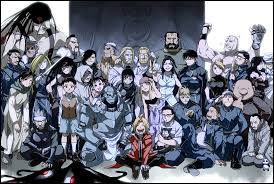 And really, I think that one of the most compelling things about the show is its characters. Let me tell you, this show has a ton of characters. You really start out with just Ed and Al, and they definitely keep their status as the main protagonist/ditagonist throughout the series, but little by little they add in more allies, more friends, more enemies, more ambiguous characters, until you have this absolute slew of characters who are all handled with grace and purpose. I read somewhere that a good supporting cast of characters need to feel like the story is their own, and the writers definitely kept this rule in mind. The characters are given enough back story and explanation so that they are totally believable. Also, each one serves a huge purpose. There are really no throw-away characters. They all change and work and grow in the hearts of the readers/watchers.
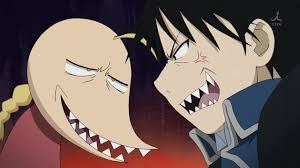
I really enjoyed the voice actors for both the sub and the dub. The first time I watched it, I saw the first two series on Netflix in English dub, and then I had to watch the last third in Japanese with English sub on Hulu, which honestly wasn't all that bad. Vic Mignogna does a very enjoyable Edward Elric in the dub, though. He's got the right amount of humor and seriousness to pull it off. And the animation - now, the animation may be my favorite animation in any animated thing ever. Probably only second to OHSHC. It's dark, it's pristine, it's fluid, and the action scenes are absolutely, mind-blowingly (not a word!) amazing. And yet, they aren't afraid to pull this every once in a while:
So, that ought to wrap things up. The basic summary of this review is that Fullmetal Alchemist: Brotherhood is perfect and without flaw as far as shows go. Well, I'm sure it's not perfect, seeing as nothing is perfect... But if there are any flaws, I haven't seen them yet!! Now, there is some questionable content for younger viewers, but it's mostly just blood and destruction, with one small instant of partial nudity, and some incredibly heart-wrenching scenes that will break your heart into a million little pieces. There's some seriously thought-provoking stuff in here, and thought-provoking doesn't exactly means it's safe for sensitive viewers. So, be prepared for some emotional decimation if you choose to step into the world of FMAB. But it is very much worth it for those who can handle it. They took the Brotherhood version off of Netflix, but you can watch the subbed version it with commercials on Hulu for free (http://www.hulu.com/fullmetal-alchemist-brotherhood). Also, for those interested in reading the manga, it can be found in its entirety here: (http://mangafox.me/manga/fullmetal_alchemist/). Enjoy!
 For those who have never watched/read/heard of Fullmetal Alchemist in any form, it first appeared in the early 2000s as a manga written by Hiromu Arawaka. While it was still being written, it was turned into an anime, which became the well-beloved original Fullmetal Alchemist. Several years later, after the complete manga was written, a second series came out, entitled Fullmetal Alchemist: Brotherhood, which follows the manga more closely. After watching both, the second one is the version I prefer, which is why I chose to review only that one.
The basic premise of the manga and the show is this: two alchemist brothers, Edward and Alphonse Elric, attempt to resurrect their mother through human transmutation, and lose an arm and leg, and their body, respectively. They spend the show attempting to get their bodies back to normal. For about the first seven episodes, they are in pursuit of the elusive Philosopher's Stone, a powerful alchemy enhancer which they are sure will aid them in returning their bodies back to normal; but when they learn a shocking secret about the Stone, the brothers are pulled into a terrible conspiracy that extends far beyond anything they ever thought possible. Along the way, they make mistakes and friends, face incredible loss, and come face-to-face with what really matters in this life.
 And really, that's all the summary I can give without delving into extremely deep explanations of alchemy and the world of Fullmetal Alchemist and other related subjects. Honestly, I started to do so and got like two paragraphs into an explanation of alchemy before I decided to just tell you to go watch the show for yourself! I think that this is one of those shows that if you try to explain it to somebody who has never seen it, you sound like a maniac. Either that, or you would have to give a forty-minute lecture on alchemy and its inner workings and a bunch of boring stuff, which, actually, isn't boring as you're learning it in the show! It's really amazing how the show gets into the depths of humanity during the 64 episodes. It seriously made me think like almost no other show I've seen. Fullmetal Alchemist: Brotherhood is basically the opposite of all the mindless garbage that comes on TV nowadays.
I really enjoyed the voice actors for both the sub and the dub. The first time I watched it, I saw the first two series on Netflix in English dub, and then I had to watch the last third in Japanese with English sub on Hulu, which honestly wasn't all that bad. Vic Mignogna does a very enjoyable Edward Elric in the dub, though. He's got the right amount of humor and seriousness to pull it off. And the animation - now, the animation may be my favorite animation in any animated thing ever. Probably only second to OHSHC. It's dark, it's pristine, it's fluid, and the action scenes are absolutely, mind-blowingly (not a word!) amazing. And yet, they aren't afraid to pull this every once in a while:
So, that ought to wrap things up. The basic summary of this review is that Fullmetal Alchemist: Brotherhood is perfect and without flaw as far as shows go. Well, I'm sure it's not perfect, seeing as nothing is perfect... But if there are any flaws, I haven't seen them yet!! Now, there is some questionable content for younger viewers, but it's mostly just blood and destruction, with one small instant of partial nudity, and some incredibly heart-wrenching scenes that will break your heart into a million little pieces. There's some seriously thought-provoking stuff in here, and thought-provoking doesn't exactly means it's safe for sensitive viewers. So, be prepared for some emotional decimation if you choose to step into the world of FMAB. But it is very much worth it for those who can handle it. They took the Brotherhood version off of Netflix, but you can watch the subbed version it with commercials on Hulu for free (http://www.hulu.com/fullmetal-alchemist-brotherhood). Also, for those interested in reading the manga, it can be found in its entirety here: (http://mangafox.me/manga/fullmetal_alchemist/). Enjoy!
| The brothers who started it all... And Winry, of course :) |
Monday, June 3, 2013
The Girl Who Leapt Through Time
 Well, I was on Youtube the other evening after I had finished reading the first two acts of Hamlet, reading half of The Strange Case of Dr. Jekyll and Mr. Hyde, and expositing Robert Frost's "Design." I have no idea how I got there, but suddenly I stumbled across the full anime movie The Girl Who Leapt Through Time. I had never heard of it before, but I assumed it was about time travel, which is one of my favorite things, so I decided to give it a go. If it was horrible, I thought, could always just turn it off and go to sleep like I should have been doing.
But when the movie opened up, I decided that I wouldn't be going to sleep anytime soon. The opening was beautiful and so simple - just a few friends playing baseball. It really contrasted with the idea I had in my head of time travel, which was complicated and fast-paced. A lot of other time-travel movies do tend to start out this way, with the calm before the chaos (Field of Dreams, Back to the Future, etc.), but it may have shocked me due to watching too much Doctor Who recently.
In the beginning of the film, you very quickly get a sense of the nature of the protagonist, Makoto Konno, as she stumbles along through the first few minutes of the movie. She is unfocused, unsure, and just plain clumsy. She freaks out very easily and has a bit of a short temper, especially with her prim and organized little sister. Her two best friends, Kōsuke Tsuda and Chiaki Mamiya, unfold more as the story goes on, though at first you get the sense that Kōsuke is the more mature, strong, and level-headed of the trio, and Chiaki is the fun-loving, sort-of rebel with a good heart. The secondary characters of the movie - the other students at the school, Makoto's family, even strangers in the park are all believable and enjoyable to watch.
| Some of the gorgeous animation |
The plot of the movie is another one of its high points, if not its highest point. The movie plays off of a well-known Japanese story called, not surprisingly, The Girl Who Leapt Through Time, or, The Time Traveler, whose protagonist is a young girl named Kazuko Yoshiyama. Through mysterious circumstances, Kazuko gains the power of time travel, and is able to make small leaps back in time. In the end, however, she is forced to part with her love, who happens to be a time traveler from the distant future. In the 2006 version, Kazuko is demoted to being the aunt of the protagonist, but her story is given some spotlight over the course of the movie.
Very much like the original story, the plot follows Makoto as she mysteriously gains the power to travel backwards in time one day while in the science lab, and the mess of serious frivolity that ensues. While the plot could very easily get tangled up in itself, as is possible with all time-travel stories, it manages to keep the charm and simplicity it opened up with. It was a sort of organized, peaceful chaos, if that is even possible.
| "Time waits for no one," the mantra of the film |
Tuesday, March 12, 2013
Ouran High School Host Club
 |
| (Top left to bottom right): Mori, Huni, Tamaki, Kyouya, Kaoru, Haruhi, and Hikaru in all of their Host Club glory! |
So, I just finished re-watching/reading the entirety of Ouran High School Host Club. I'm telling you, when I get into something, I get into it! But anyways, I actually ended up enjoying this anime and manga far more than I anticipated at first; and I loved watching it way more the second time than the first time. Honestly, at first, the characters sort of shocked me a little bit and I didn't know how to take them, because they're all just so flamboyant and insanely funny; but then, as I kept watching and reading, I found the heart of the characters and the story, and might have fallen a little bit in love with it.
Here's a run-down for those who know nothing about it: OHSHC is basically a shojo manga/anime story about a girl named Haruhi Fujioka, a scholarship student at the elite prep school, Ouran Academy in Japan. One day, while trying to find a place to study quietly, Haruhi stumbles into Music Room #3, the meeting-room of the Ouran High School Host Club! The members are 6 extremely handsome, rich, and well-mannered young men whose job it is to entertain and flatter the young women who visit the club; sort of like reverse-gender geishas. When she breaks a valuable vase that belonged to the Club, Haruhi is forced to work for the Host Club in order to repay her debt, first as an errand-boy, and then as a host. Ah, and did I mention that everyone in school thinks that she is a boy? However, the Host Club realizes her true identity rather quickly, and from there everything gets highly interesting.
The show gets most of its energy, at least in the beginning, from the antics of the Host Club
 |
| "I will drink this coffee!!!!" |
 |
| The Host Club boys in Wonderland... |
And of what have I been reminded/ learned from this anime/manga? That friends are there to help us through the toughest and most confusing of times. That revealing your feelings and thoughts about a situation makes things about 100% less complicated and easier on everyone involved. That if you turn your back on the world, the world will turn its back on you (a loose reference to the Lion King, I think?) - that is, a life lived in the safety of being shut up within itself may be safe, but it is lonely beyond measure. Certainly, with opening yourself up even a little to others is terrifying and comes with an almost guaranteed risk of being hurt, but the benefits vastly outweigh the risks. That any friendship worth your salt will not break easily. That every day is an experience, and should be made the best of, even if it is hard. And, most importantly, that all people are idiots - but they are worth getting to know and reaching out to anyways. We all have a story and a lesson to tell others.
| The "Family" :) |
Quite surprising lessons from a simple soujo reverse-harem manga, eh?
So, to conclude, I would recommend this anime and manga to anybody who is looking for a light, fun story with hilarious characters who are far deeper than they seem - mostly girls, as I don't see guys being all that into this story. There are some issues with cross-dressing (such as Haruhi hiding her gender and her father being a transvestite) and homosexuality (a.k.a. "twincest," although they are only putting on an act, and the Host Club guests fangirling over the supposed "love quadrangle" in the Club), but if you can get past those elements then you can find a story with a lot of heart, and an adorable love story to boot.
*** Spoiler Alert:
I just had to... They're so cute!!! |
Thursday, November 8, 2012
"Jekyll"
| "Everybody has a dark side" |
As Moffat explains, Jekyll is meant to be a modern-day sequel (not retelling) of the Robert Louis Stevenson novel "The Strange Case of Dr. Jekyll and Mr. Hyde." The story focuses on Dr. Tom Jackman (James Nesbitt), who, as a descendant of the original Dr. Jekyll, has inherited the family curse. Jackman has left his family, for their own protection, and spends most of his time in his secret hideout with his psychiatric nurse, Katherine Reimer (Michelle Ryan), who keeps an eye on both Jackman and his alter-ego, the infamous Hyde (also played by Nesbitt). Jackman and Hyde, at the beginning of the show, have a simply agreement and live in relative peace: Hyde is not allowed to kill anybody, or Jackman will turn himself in; and Jackman is not allowed to search for a cure, or Hyde will kill them both. Neither has the memories of the other, but they communicate via recording device. However, Hyde accidentally finds out about Jackman's family, his wife Claire (Gina Bellman), and their twin boys, which starts much of the conflict between Jackman and Hyde. Jackman fears for his family's safety when they are exposed to Hyde, who has not hesitated to torture or maim people.
| Dr. Jackman attempting to restrain Hyde |
The real intrigue starts, however, with the introduction of the firm of Klein and Utterson, an organization which has been tracking Jackman/Hyde. Jackman's "friend," Peter Syme (Denis Lawson), and a mysteriously annoying American (of course!) named Benjamin (Paterson Joseph) are heading up the operation. When Jackman travels to Syme's house to confront and question his friend, he unintentionally releases Hyde upon his wife, Claire, who turns out to be far more feisty than she seems, and the two start an unusual and important relationship. Eventually, Benjamin and company corner Hyde in Syme's house and "explicitly" threaten Claire and the twins; at which point, Hyde officially kills somebody for the first time. Which lets you know that it's about to get interesting, because why would Hyde, a monster, defend Jackman's family?
| Hyde being threatening - Tell me the kid doesn't look like a psychopath! |
Soon after Jackman turns himself in for murder, he is captured by Klein and Utterson, and locked in a special box which "cures" him by killing off Jackman and leaving only Hyde in Jackman's body. Hyde is supposedly "the next step in evolution," and Klein and Utterson want to use his DNA to find cures for cancer and other such world-saving things. (But, I'm just saying, if Hyde was the next step in evolution, I'd like to stay just as I am, thank you, and not turn into a murderous psychopath!) What follows I really shouldn't reveal, and I left out a bunch of the plot, but it's definitely worth watching. James Nesbitt pulls off an excellent bit of acting, pretty much on par with Robert Carlyle's portrayal of Rumplestiltskin in Once Upon a Time. The physical differences between Hyde and Jackman aren't that great, besides different hair and eyes; yet you can't help but believe that these are two completely different men. Jackman is a timid, calm, cool, and collected man with a good heart, who just wants to be with his family and escape his dangerous alter-ego. Hyde, on the other hand, is a complete psychopath. You can't help but feel disgusted with him for most of the show. He threatens helpless girls, sleeps with just about everything that walks, beats up people to the point of near-death, and pretty much bites peoples faces off. He is, in a word (or two), creepy and insane!
| Hyde and Claire |
So, all in all, I would definitely recommend this thrilling, intriguing, and mind-bending show, if you're able to handle the content - there are a lot of sexual references, threats, and scenes thanks mostly in part to Hyde, as well as a lot of high-end swearing, with a lot of dropped f-bombs and misuses of Christ's name. So, it's definitely not for everybody, but if you can get past those aspects you will find an excellent miniseries that makes you do what any good example of literature is meant to do - think.
Friday, August 10, 2012
Fruits Basket
A few months ago my friends and I somehow got on the subject of anime, and one of them recommended that I should watch Fruits Basket. At first, when she told me what it was about, I thought it sounded really wierd. Apparently, there's this really sweet girl who's living in a tent in the woods when she comes across this family, mostly made up of boys. This family, the Sohma family, decides to let Tohru stay with them, but what Tohru eventually learns is that the family is under a curse. Whenever they are really stressed out or hugged by someone of the opposite gender, they turn into one of the twelve animals of the Chinese zodiac. Even though this anime is set in Japan. Oh well. Anyways, the Sohmas take her in, and the rest of the series is basically about their misadventures and the breaking of the Sohma curse.
I thought it sounded okay, so I gave it a go. And really, even though the series has its uber-wierd and slightly awkward moments, it was pretty amazing. I thought that Tohru Honda, the girl protagonist, would annoy the crap out of me. Well, she did a little, because she's just so dang cheery all the time, but I mostly ended up liking her strength of spirit to be happy in spite of recently losing her mother, and her selflessness. Tohru never thinks of herself. She spends all of her time thinking of how to make those around her feel happy and welcome; and in one instance in the series, she even spends all of her hard-earned money to buy her "family" Valentine's day chocolates.
The first three Sohmas whom Tohru meets are Shigure, the dog of the zodiac and a novelist/pervert; Yuki, the purple-haired rat and the self-conscious "Prince" of the school; and Kyo (Lord, I hate being a fangirl, but... fangirl scream!!! AHHH!!!) the orange-haired cat of the family who has major anger issues. See, the cat is basically the utter outcast of the zodiac, and thus the outcast of the Sohma family. To see the whole story, watch the anime!
Over the scope of the series, which is quite impressive, Tohru meets various other Sohmas, such as Ayame, the snake and Yuki's older brother; Hatori, the "dragon" of the zodiac and the mysterious family doctor; Rin, the horse of the family who also struggles with some anger issues; Haru, the cow whom you do NOT want to upset; and Momiji (another one of my favorites), the rabbit of the zodiac who looks way younger than he really is. All in all, they were a very colorful, intriguing, and fun cast of characters, each of whom I came to love and care about. All of them struggled with anger and pain due to neglect and abuse and the hands of their leader, Akito; but Tohru helps each of them to overcome their struggles and issues with her enduring cheerfulness and strength of character. That is most of why I loved this anime. There were a lot of lessons to be learned from watching the lives of these characters, such as how to love somebody more than yourself, that happiness is a choice, and that forgiveness is the most powerful thing in the world. It is also downright hilarious, and never gets bogged down in the heavy issues it represents. And lastly, who can ignore the romantic conflict in this shojo anime??? Tohru-Yuki, Tohru-Kyo, Tohru-Momiji... who will she end up with???
So all-in-all, I would definitely recommend this award-winner to anybody who would love a good, solid anime; and not just girls, although there are a lot of guys in this anime to fangirl-swoon over. Apparently this show has a large male fan base, and has a lot for them as well. It is definitely NOT just about romance. If it was, I probably would not be recommending it right now. But even more than watching the anime (which can be found on Netflix dubbed), I would very much recommend the manga, which tells the rest of the story that the 26 anime episodes only begin to unfurl. You can read it here; I'm pretty sure I read it all in about 5 days in the middle of studying for exams (http://mangafox.me/manga/fruits_basket/).
A Tale of Two Cities by Charles Dickens
“It was the best of times, it was the worst of times…” So begins Charles Dickens’s fantastic novel, A Tale of Two Cities. The book was published in 1859, and has since grown to become one of the most famous books of all time. It was Dickens’s aspiration, when writing the tale, to chronicle the events of the French Revolution in an enjoyable way. But when he finished, the Revolution wasn’t the only theme of the book. There is one recurring theme, which can be described in the phrase“recalled to life.” The entire tale practically revolves around this theme. In fact, the book begins and ends with it- in the recalling to life of a scarred, half- dead prisoner, and in the recalling to life of an uncaring, miserable man.
The time period of this book was a cruel and trying one. The bloody French Revolution plays a large part of the book, although most of the tale takes place in the years beforehand- years of pomp, pageantry, and poverty in Paris , and years of crime and disorder in London England ; there were a king with a large jaw and a queen with a fair face, on the throne of France England France and England
Just as there are many settings in the tale, there are many characters. Most, such as Jerry Cruncher or Miss Pross, have relatively small roles, while others, such as Charles Darnay, a.k.a. the Marquis St. Evremonde, the good and decent husband of Lucie Manette; Mr. Jarvis Lorry, the business- minded yet kindhearted Tellson banker; and Monsieur Defarge, the French wine shop keeper / revolution leader, play larger roles. But the character who seems to stand out above the rest is Sydney Carton, a brilliant lawyer from London
In describing Carton’s hopelessness, Dickens writes, “Waste forces within him, and a desert all around, this man stood still on his way across a silent terrace, and saw for a moment, lying in the wilderness before him, a mirage of honorable ambition, self- denial, and perseverance. In the fair city of this vision, there were airy galleries from which the loves and graces looked upon him, gardens in which the fruits of life hung ripening, waters of Hope that sparkled in his sight. A moment, and it was gone. Climbing to a high chamber in a well of houses, he threw himself down in his clothes on a neglected bed, and its pillow was wet with wasted tears. Sadly, sadly the sun rose; it rose upon no sadder sight that the man of good abilities and good emotion, incapable of their directed exercise, incapable of his own help and his own happiness, sensible of the blight on him, and resigning himself to let it eat away.” But as the tale goes on, it becomes apparent that Carton is changing, forsaking his apathetic attitude and exchanging it for a determined, caring one. His only motivation is the love and kindness of Lucie Manette, Darnay’s wife. It is obvious that Carton loves Lucie, and he tells her that he would give even his life to keep her and those she loves happy.
This contributes to the book’s central theme in that Carton, at the beginning of the book, can be considered“dead.” He is living with no purpose or direction or motivation. But Carton is willing to sacrifice even his life to make Lucie happy, which he eventually does, and in his death, he is recalled back to life, love, peace, and happiness.
When Dickens first wrote A Tale of Two Cities, it wasn’t as a novel. He wrote the story in short installments, which were published weekly in a magazine. The installments were eventually bound together in book form, and were then further divided into three segments entitled Recalled to Life, The Golden Thread, and The Track of a Storm. The first segment, Recalled to Life, mainly tells of the rescue of Dr. Manette, a French doctor who has just been released from the Bastille after eighteen years of imprisonment. His aid comes in the form of an old acquaintance, Mr. Jarvis Lorry, who arrives in Paris to take the Doctor back to the safety of London France Paris Paris London
Every good story has a main conflict. It is that familiar struggle between good and evil, between morality and sin, and even sometimes between pomp and poverty. In the case of A Tale of Two Cities, the main conflict is between the belligerent peasants and the neglectful aristocrats of Paris Frances France
At this point in the book, the French Revolution has not yet begun. It is only an idea, the impossible dream of a few starving, desperate, poverty- ridden peasants. But it is coming. Death is just over the horizon. It will not be long before the streets of Paris Paris Paris
***(Please, note, this is a project for school I wrote my senior year of high school... But it also gives a good summary of one of my favorite books!)
Subscribe to:
Posts (Atom)